Handmade With Love

Category: Snead Eye Group

  • Workplace Eye Wellness/Safety

    Workplace Eye Wellness/Safety

    March is Workplace Eye Wellness and Safety Month.

    When considering “eye wellness and safety” at work, many of us imagine an industrial setting with orange safety vests, hard hats, and protective goggles. Certainly, eye safety measures must be taken at industrial work sites, but all other workplaces must remain vigilant about increasing eye wellness and reducing injury hazards too.

    HOW COMMON ARE WORK-RELATED EYE INJURIES?

    Very common. More than 2,000 people injure their eyes at work each day. About 1 in 10 injuries require one or more missed workdays for recovery. Of the total amount of work-related injuries, 10-20 % will cause temporary or permanent vision loss. Experts believe that proper eye protection could lessen the severity —or even prevent— 90% of eye injuries that occur because of work accidents. *

    *Source: PreventBlindness.org

    Common causes for eye injuries in several work situations include:

    • Flying objects (bits of metal, glass)
    • Tools
    • Particles
    • Chemicals
    • Harmful radiation
    • Any combination of these or other hazards

    “I WORK IN AN OFFICE,” you might say. “WHY SHOULD I BE CONCERNED ABOUT EYE INJURY?”

    Believe it or not, for employees who utilize computers in their workplace, there are many eye-related concerns. While far less subtle than, say, flying debris, computer-related eye hazards can be just as dangerous to eye health over the course of time. With so many employees relying on a computer screen for their day-to-day functions, it’s no wonder computer eye strain has become a major job-related complaint. According to AllAboutVision.org, studies show that eye strain and other bothersome visual symptoms occur in 50 to 90 percent of computer workers. “Problems can range from physical fatigue, decreased productivity and increased numbers of work errors, to minor annoyances like eye twitching and red eyes,” the organization states.

    An increasingly-common condition called COMPUTER VISION SYNDROME (CVS) is a growing concern for health care providers, employees and employers. CVS is a condition resulting from focusing the eyes on a computer or other display device for prolonged, uninterrupted periods of time. Some symptoms of CVS include headaches, blurred vision, neck pain, fatigue, eye strain, dry eyes, irritated eyes, double vision, vertigo/dizziness, polyopia (the perception of several visual images of one object), and difficulty refocusing the eyes. These symptoms can be further aggravated by improper lighting conditions such as glare or bright overhead lighting, or air moving past the eyes from overhead vents or a fan.

    PREVENTATIVE MEASURES AGAINST COMPUTER VISION SYNDROME (CVS)

    To decrease the chances of developing CVS, Snead Eye Group recommends the tried-and-true “20/20/20 Rule.” Here’s how it works: Every 20 minutes, look at something 20 feet away for 20 seconds.

    For added physical and mental health benefits, depending on your schedule and personal situation, incorporate body movements along with the “20/20/20 Rule” by moving around – preferably away from your computer screen! Take a water cooler break. Visit a coworker for a brief chat. Check the mail. Weather-permitting, get outside and make a brief call to a loved one. Whatever it takes, just get away from the computer for short intervals! Moving away from your workstation will reduce eye strain, increase alertness, and keep you performing at your best.

    CALCULATING THE COST

    From a humanitarian standpoint, most companies want their employees feeling good and living productive lives for their own sake. But also, from a financial standpoint for the sake of an employer, there’s a distinct business advantage to encouraging healthy eye practices. According to the United States Department of Labor’s Occupational Safety and Health Administration (OSHA), “Eye injuries alone cost more than $300 million per year in lost production time, medical expenses, and worker compensation.”

    In summary, the more vision ailments employees have, the more medical care they may require, increasing healthcare-related expenses for both themselves and their employers. So, for your personal enjoyment of everyday life, and for the sake of keeping healthcare costs down, Snead Eye Group encourages wise eye-safety practices in your workplace, no matter the type of environment.

  • Existing in a Sunshine State

    Existing in a Sunshine State

    [et_pb_section fb_built=”1″ admin_label=”section” _builder_version=”3.22″ global_colors_info=”{}” theme_builder_area=”post_content”][et_pb_row admin_label=”row” _builder_version=”3.25″ background_size=”initial” background_position=”top_left” background_repeat=”repeat” global_colors_info=”{}” theme_builder_area=”post_content”][et_pb_column type=”4_4″ _builder_version=”3.25″ custom_padding=”|||” global_colors_info=”{}” custom_padding__hover=”|||” theme_builder_area=”post_content”][et_pb_text admin_label=”Text” _builder_version=”4.13.1″ background_size=”initial” background_position=”top_left” background_repeat=”repeat” hover_enabled=”0″ global_colors_info=”{}” theme_builder_area=”post_content” sticky_enabled=”0″]

    Existing in a Sunshine State

    The Top 3 Health Reasons to Love the SUN!

    Sunshine State It may not be December, but for many of us in SWFL, “It’s the most wonderful time of the year!”The car carriers have headed north, our streets are less congested, restaurant lines are nonexistent and there’s finally room to spread out at the beach again! Yes, once again, May has ushered in “un-season” in Florida.

    This month, we also celebrate all the Moms out there: Happy Mother’s Day!

    Moreover, at month’s end, we’ll take a pause from work and civic duty to honor the men and women who died while serving in the U.S. military on Memorial Day.

    May is also Ultraviolet Awareness Month. With that in mind, we thought this was an opportune time to share important health information about the beloved center of our solar system, the SUN.

    First and foremost, please protect your eyes when you’re out enjoying the rays! Exposure to UV rays can burn delicate eye tissue and raise the risk of developing cataracts and cancers of the eye. Do your eyes a favor: click here to schedule an appointment so you can learn whether our beautiful Florida sun has negatively affected your eyes throughout the years. The earlier we both learn about any condition that might require treatment, the better we can address your specific need/s.

    Now, if you promise to protect your eyes, read on to learn the top 3 GREAT things about being in a SUNSHINE STATE.

    Snead Eye Group SunglassesNumber 1: SUNSHINE ACTIVATES VITAMIN D

    Our bodies naturally produce vitamin D when we expose them directly (in healthy doses) to sunshine. In fact, some people call vitamin D “the sunshine vitamin.” Vitamin D, a fat-soluble vitamin in a family of compounds that includes vitamins D-1, D-2, and D-3, influences as many as 2,000 genes in your body!

    So, what does vitamin D do for you exactly? A lot!

    Its principal roles are that of regulating the absorption of calcium and phosphorous. According to Professor Michael Holick, of Boston University School of Medicine and author of The UV Advantage, “We get about 90 to 95 per cent of our vitamin D from the sun. It is essential for absorbing calcium, keeping our bones healthy, and for protecting against serious chronic diseases later in life such as osteoporosis, Type II diabetes, multiple sclerosis and many common cancers.”

    To boost vitamin D levels, some experts recommend we get 5 to 15 minutes of sun exposure per day, at least three times a week. Luckily here in Florida, that’s not hard to do! Just, please, do so while wearing a quality pair of UV-blocking sunglasses!

    Number 2: SUNSHINE FIGHTS DEPRESSION

    Our body’s natural “happy hormone” is serotonin, and serotonin’s best booster is —you guessed it— pure sunshine. Especially when combined with moderate exercise such as a walk around the block, sun exposure can relieve mild cases of depression! Serotonin in larger quantities can also help suppress our appetite which may result in less feelings of regret about overeating. Additionally, it seems that more endorphins (groupings of peptide hormones that bind to opiate receptors in the brain which reduce the sensation of pain and positively affect emotions) are released when we exercise outdoors as opposed to indoors.

    Number 3: SUNSHINE BOOSTS YOUR IMMUNE SYSTEM

    Sunshine naturally encourages the production of white blood cells, which help to boost your immune system and fight infection. According to some researchers, sunlight exposure seems to rev up T cell production and activity throughout our bodies. A more scientific term for T cell is “T lymphocyte” which refers to a particular subtype of white blood cell that plays a central role in cell-mediated immunity.

    T cells are like our bodies’ little soldiers that work around the clock to seek out pathogens and attack them. When they’re revved up and moving freely, they can do a better job fighting infections and even some types of cancer.

    In summary, this month, please be aware of UV rays, both their negative and positive attributes! Get out there and let your skin (but please, not your eyes) soak up some sun, but don’t overdo it!

    [/et_pb_text][/et_pb_column][/et_pb_row][/et_pb_section]
  • Brownie Muffins

    Brownie Muffins

    Yum Yum Brownie MuffinsYum Yum Brownie Muffins

    Per muffin: 181 calories (without chocolate shavings), 3.5g fat, 357 mg sodium, 37g carbs, 2g fiber, 20g sugars, 2g protein.

    Ingredients (MAKES 12 SERVINGS)
    1 box moist-style devil’s food cake mix (15.25 to 18.25 oz.)
    One 15-oz. can pure pumpkin
    Shavings from a chocolate bunny (Snead Eye’s special spring recipe variation.)

    Directions
    Preheat oven to 400 degrees. Line a 12-cup muffin pan with foil baking cups, or spray with nonstick spray.

    In a large bowl, mix cake mix with pumpkin until completely smooth and uniform. (Batter will be quite thick.) Evenly distribute batter into the cups of the muffin pan. Press chocolate bunny shavings into muffin tops with the back of a spoon, approximately 1 tablespoon per muffin.

    Bake until a toothpick inserted into the center of a muffin comes out mostly clean, about 20 minutes.

    Enjoy!

    Basic recipe (without chocolate bunny shavings) courtesy of

    Hungry girl

  • Kale The King

    Kale The King

    [et_pb_section fb_built=”1″ admin_label=”section” _builder_version=”4.16″ global_colors_info=”{}” theme_builder_area=”post_content”][et_pb_row admin_label=”row” _builder_version=”4.16″ background_size=”initial” background_position=”top_left” background_repeat=”repeat” global_colors_info=”{}” theme_builder_area=”post_content”][et_pb_column type=”4_4″ _builder_version=”4.16″ custom_padding=”|||” global_colors_info=”{}” custom_padding__hover=”|||” theme_builder_area=”post_content”][et_pb_text admin_label=”Text” _builder_version=”4.16″ background_size=”initial” background_position=”top_left” background_repeat=”repeat” global_colors_info=”{}” theme_builder_area=”post_content”]

    kale eyesALL KALE THE KING:
    In March, the Wearin’ o’ the Green Meets the Eatin’ o’ the Green

    March isn’t just a celebration of all things Irish, it’s also National Nutrition Month® as designated by the Academy of Nutrition and Dietetics. And guess what? Your eyes need nutrition too!

    But jeepers creepers, what to feed those peepers? Carrots and other orange-colored fruits and vegetables? Of course! Your Mom wouldn’t lead you astray. A specific type of vitamin A called beta carotene, which gives carrots their cheerful orange color, helps the retina and other parts of the eye to function smoothly.

    Your body converts beta carotene to vitamin A to help prevent dry eyes and night blindness as well as fend off various diseases. Even beyond carrots, other deep orange foods like sweet potatoes and butternut squash can also infuse that important beta carotene and vitamin A into your system.

    However, beta carotene-rich orange foods have some close cousins like kale and spinach that are green with envy over all the eye-health fame that carrots have always gobbled up.

    eye healthPer EatRight.org, the dark green leafy variety of foods pack a powerful vitamin-rich punch of lutein and zeaxanthin (related to vitamin A and beta carotene) which are “…believed to protect eye tissues from sunlight damage and reduce the risk of cataracts and macular degeneration.” The macula, the part of the retina that acts as a natural sunblock, stores lutein and zeaxanthin to help absorb blue light which is becoming increasingly important as we look at digital devices so frequently.

    Without getting too complicated, blue light is a natural part of the visible light spectrum, but it reaches deeper into the eye than other parts of the light spectrum – when compounded over time, blue light can potentially cause damage to the retina.

    While blue light is totally natural (sunlight, very beneficial to good our well-being in healthy quantities, is its main source), there are various man-made sources of blue light that have eyecare professionals looking closely at possible long terms effects of blue light on eye health. Digital display screens such as computers, TVs, tablets, smartphones, etc. don’t emit nearly as much blue light as the sun, but the proximity of these screens to our eyes and the amount of time spent looking at them are all very good reasons to load up on the nutrients in deep green veggies and other eye health-boosting whole foods.

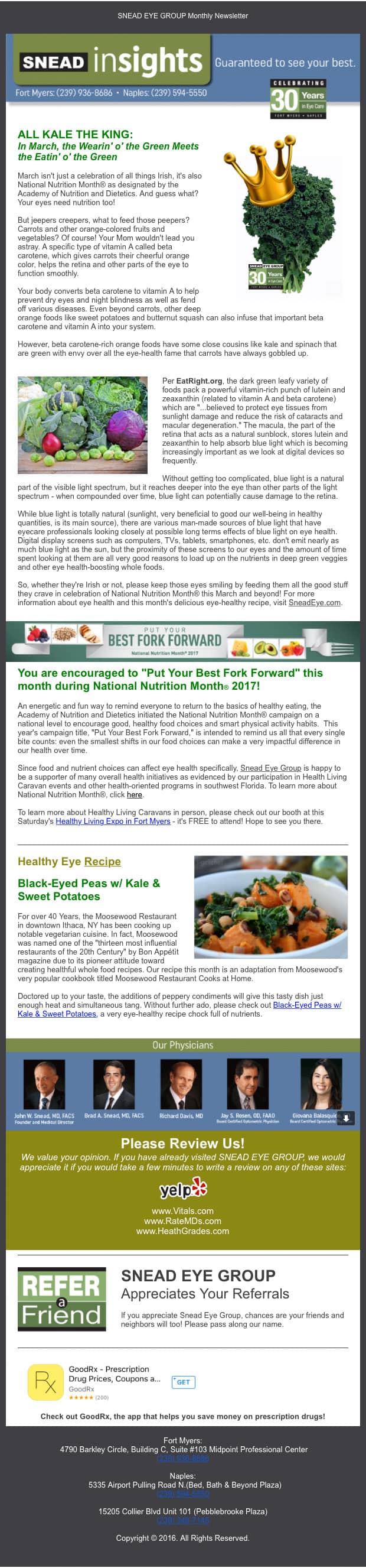
    So, whether they’re Irish or not, please keep those eyes smiling by feeding them all the good stuff they crave in celebration of National Nutrition Month® this March and beyond! For more information about eye health and this month’s delicious eye-healthy recipe, visit SneadEye.com.

    To view this Snead Insights article in its full form, Click Here!

    [/et_pb_text][/et_pb_column][/et_pb_row][/et_pb_section]

  • Dr. Rosen Shares Vision with Lighthouse of SWFL

    Dr. Rosen Shares Vision with Lighthouse of SWFL

    [et_pb_section fb_built=”1″ admin_label=”section” _builder_version=”3.22″ global_colors_info=”{}” theme_builder_area=”post_content”][et_pb_row admin_label=”row” _builder_version=”3.25″ background_size=”initial” background_position=”top_left” background_repeat=”repeat” global_colors_info=”{}” theme_builder_area=”post_content”][et_pb_column type=”4_4″ _builder_version=”3.25″ custom_padding=”|||” global_colors_info=”{}” custom_padding__hover=”|||” theme_builder_area=”post_content”][et_pb_text admin_label=”Text” _builder_version=”4.14.6″ background_size=”initial” background_position=”top_left” background_repeat=”repeat” hover_enabled=”0″ global_colors_info=”{}” theme_builder_area=”post_content” sticky_enabled=”0″]

    Snead Eye Group’s Dr. Rosen Shares Vision with Lighthouse of SWFL

    In the words of Helen Keller, “The only thing worse than being blind is having sight but no vision.” Thankfully, the leadership team of The Lighthouse of SWFL has the vision required to understand and meet the many needs of southwest Florida’s blind and sight-impaired residents; Snead Eye Group shares and actively supports that vision as well.

    Lighthouse of SWFL is a United Way Partner agency with a mission to enable people of all ages living with a visual impairment or blindness to remain independent, active and productive in society. Snead Eye Group’s Dr. Jay S. Rosen, OD, FAAO, demonstrates his commitment to that mission by serving on the Board of Directors of The Lighthouse of SWFL in the capacity of Director.

    Dr. Rosen has been an active member and integral part of Lighthouse’s Board of Directors since September, 2011; he was enthusiastically recommended by Read More

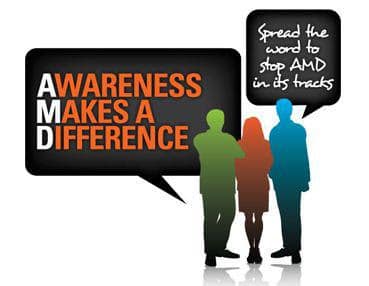
    February is AMD/LOW Vision Awareness Month!

    awarenessAge-related macular degeneration is a leading cause of vision loss, affecting more than 15 million Americans age 50 and older.

    AMD primarily destroys the sharp central vision controlled at the back of the retina by the macula and can develop so slowly that it is not until vision is severely affected that a patient may begin to notice. Try this to get an idea of what AMD is like: Close your left eye. Make a fist with your right hand. Put your fist in front of your right eye. All you will see are objects in the periphery of your sight. This is how someone affected by AMD may see the world. Sharp central vision is obviously needed to read, drive, watch television and perform other daily tasks that require straight ahead vision.

    Risk factors, which you can control, include High blood pressure, high cholesterol, obesity and smoking. Risks you cannot control include age, family history, gender and race.

    How do you know if you may be affected by AMD? Symptoms include straight lines or faces appearing wavy, doorways which appear crooked and objects appearing smaller or farther away than they really are.

    If you or someone you know thinks they may be experiencing any of these issues, it is vitally important to see a SNEAD EYE GROUP professional for an evaluation and diagnosis. Drug therapies, injection, laser therapy, and even tiny, implantable devices which magnify images onto the retina, are all possible treatments for AMD. It is important see a knowledgeable ophthalmologist such as Dr. John or Dr. Brad Snead at SNEAD EYE GROUP to discuss your options.

    [/et_pb_text][/et_pb_column][/et_pb_row][/et_pb_section]
  • Lighthouse of SWFL

    Lighthouse of SWFL

    Lighthouse of swflIn the words of Helen Keller, “The only thing worse than being blind is having sight but no vision.” Thankfully, the leadership team of The Lighthouse of SWFL has the vision required to understand and meet the many needs of southwest Florida’s blind and sight-impaired residents; Snead Eye Group shares and actively supports that vision as well.

    Lighthouse of SWFL is a United Way Partner agency with a mission to enable people of all ages living with a visual impairment or blindness to remain independent, active and productive in society.  Snead Eye Group’s Dr. Jay S. Rosen, OD, FAAO, demonstrates his commitment to that mission by serving on the Board of Directors of The Lighthouse of SWFL in the capacity of Director.

    Dr. Rosen has been an active member and integral part of Lighthouse’s Board of Directors since September, 2011; he was enthusiastically recommended by Dr. Angela Kaplan, a Board Member at that time. Within those years of service, he has made many valuable leadership contributions as a board member, including the strengthening of Lighthouse’s relationship with the Southwest Florida Optometric Association.

    With his expertise as an eye specialist, Dr. Rosen brings a much-appreciated perspective to Lighthouse of SWFL in every aspect of his involvement with the organization from attending monthly board meetings, fundraiser events, and other Lighthouse functions.

    “Dr. Rosen is always a positive, committed supporter of the Lighthouse of SWFL,” says Linn Higgins, Executive Assistant/Human Resources Coordinator of Lighthouse. “He truly cares about people experiencing vision loss.”

    For more information about Lighthouse of SWFL, visit www.lighthouseswfl.org, email aturner@lighthouseswfl.org, or call 239-997-7797.

  • Black Bean and Mango Salad

    Black Bean and Mango Salad

    Healthy Eye Recipe Snead Eye GroupGood nutrition and vision go hand in hand.  Eating a diet with a variety of foods loaded with key nutrients for maintaining and improving eye health can help you maintain better sight.  This black bean and mango salad recipe from eyefoods.com serves two, is easy to make, and is loaded with antioxidants that are good for your eyes as well as your tummy!
  • Telemundo interviews Dr. Giovana Balasquide

    Telemundo interviews Dr. Giovana Balasquide


    Dr. Balasquide was interviewed by the Southwest Florida Telemundo affiliate January 23, 2017. During the Spanish language interview,Dr. Balasquide discussed the eye-health risks associated with being of Latino descent in Southwest Florida. She explains what eye diseases are most common in the Hispanic community and how annual eye exams can help latinos see well. Dr. Balasquide also reveals the importance of annual eye exams for eye health and for the health of the rest of the body.

  • Dr. Balasquide interview – Univision

    Dr. Balasquide interview – Univision

    [et_pb_section fb_built=”1″ admin_label=”section” _builder_version=”3.22″ global_colors_info=”{}” theme_builder_area=”post_content”][et_pb_row _builder_version=”4.14.2″ _module_preset=”default” global_colors_info=”{}” theme_builder_area=”post_content”][et_pb_column type=”4_4″ _builder_version=”4.14.2″ _module_preset=”default” global_colors_info=”{}” theme_builder_area=”post_content”][et_pb_video src=”https://www.youtube.com/watch?v=X7DuaGZ5pA4″ _builder_version=”4.14.2″ _module_preset=”default” hover_enabled=”0″ global_colors_info=”{}” theme_builder_area=”post_content” image_src=”//i.ytimg.com/vi/X7DuaGZ5pA4/hqdefault.jpg” sticky_enabled=”0″][/et_pb_video][/et_pb_column][/et_pb_row][et_pb_row _builder_version=”4.14.2″ _module_preset=”default” global_colors_info=”{}” theme_builder_area=”post_content”][et_pb_column type=”4_4″ _builder_version=”4.14.2″ _module_preset=”default” global_colors_info=”{}” theme_builder_area=”post_content”][et_pb_text _builder_version=”4.14.2″ _module_preset=”default” global_colors_info=”{}” theme_builder_area=”post_content”]

    Snead Eye Group’s own Dr. Balasquide was interviewed on Univision Spanish speaking television on January 17th, 2017. Our newest doctor, Dr. Balasquide is bi-lingual speaking both English and Spanish.

    Dr. Balasquide helps people with their vision at the new Naples Snead Eye Group eye care office at Pebblebrooke Center. In this Spanish language interview, Dr. Balasquide answers some important questions regarding the eye-health risks faced by the Latino population in Southwest Florida.

    [/et_pb_text][/et_pb_column][/et_pb_row][/et_pb_section]

  • Snead Insights

    Snead Insights

    [et_pb_section fb_built=”1″ admin_label=”section” _builder_version=”3.22″ global_colors_info=”{}” theme_builder_area=”post_content”][et_pb_row admin_label=”row” _builder_version=”3.25″ background_size=”initial” background_position=”top_left” background_repeat=”repeat” global_colors_info=”{}” theme_builder_area=”post_content”][et_pb_column type=”4_4″ _builder_version=”3.25″ custom_padding=”|||” global_colors_info=”{}” custom_padding__hover=”|||” theme_builder_area=”post_content”][et_pb_text admin_label=”Text” _builder_version=”4.14.6″ background_size=”initial” background_position=”top_left” background_repeat=”repeat” hover_enabled=”0″ global_colors_info=”{}” theme_builder_area=”post_content” sticky_enabled=”0″]

    tecnis eyes“I can see clearly now the rain is gone, I can see all obstacles in my way.” Metaphorically speaking, most of us understand these iconic lyrics from the popular song released in 1972 by Johnny Nash. But from a literal standpoint, in the United States alone, there are 11 million people and growing who cannot see clearly due to a common vision disorder known as presbyopia .

    Often referred to as “the aging eye condition,” presbyopia refers to the decreased ability, over time, to change between focusing on close and far objects. Do you remember the day you had to hold the ingredient label at arm’s length in order to read it? You are far from alone. Worldwide, nearly 1.7 billion people have presbyopia and that number is expected to soar to 2.1 billion by 2020. (1)

    In a healthy eye, the natural lens is a transparent structure that, along with the cornea, helps to refract light to be focused on the retina. The lens, by changing shape, functions to change the focal distance of the eye so that it can focus on objects at various distances. Read more


    glaucoma January is National Glaucoma Awareness Month, an important time to spread the word about this sight-stealing disease.

    Glaucoma is called “the sneak thief of sight” since there are no symptoms and once vision is lost, it’s permanent. As much as 40% of vision can be lost without a person noticing. Read more from glaucoma research foundation here.


    To view this Snead Insights article in its full form, Click Here!

    [/et_pb_text][/et_pb_column][/et_pb_row][/et_pb_section]